![atlantic_pumps_logo.jpg]](https://pages.atlanticpumps.co.uk/hs-fs/hubfs/atlantic_pumps_logo.jpg?height=50&name=atlantic_pumps_logo.jpg)
| Overview | Product Details |
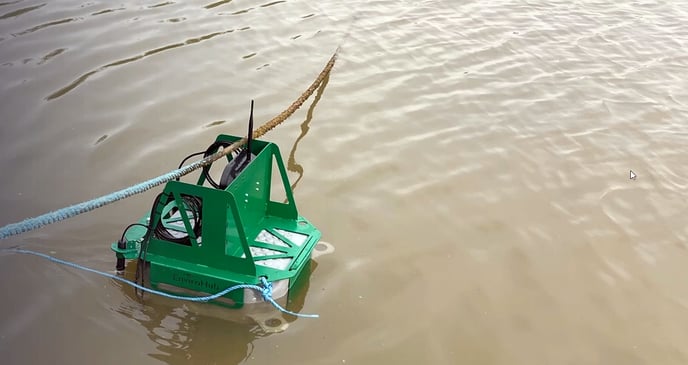
| A new EnviroHub floating turbidity monitor probe enables an upgrade to lagoon dewatering. The new control sensor floats next to the pump inlet, replacing a 'downstream' inflow probe for tighter response to changing turbidity. |
|
Challenge
Monitoring water quality in dewatering operations is essential to remaining compliant with environmental protection law, and discharge licenses/permits.
Many dewatering systems are fitted with sensors that stop pumping operations when out-of-spec water is detected. However, dealing with the quality issue and knowing when discharges can start again often involves manual intervention. With basic systems, there’s also the risk that a small quantity of contaminated water could escape before the trigger takes effect.
Stopping the dewatering pump is the easier part, but dealing with the in-pipe dirty water and automating the restart is more challenging.
In the case of this sand quarry, it was turbidity that was of concern. The first control system installed was based on forecasted settlement time; after a pre-set time delay to allow for gravity settlement in the lagoon, the dewatering cycle reset and the pump restarted. If settlement was taking longer, the system would perform another shutdown.
The main problem with this arrangement was that the pre-set time delay rarely matched the settlement rate. With at least three variables involved – weather, site activity, and silt composition, the ideal settlement time was difficult to attain.
An earlier improvement to the dewatering system saw the addition of a sampling loop which consisted of an Audex submerged pump, an EnviroHub Monitoring Unit (MU) and Control Module (CM), which fed into the control panel for the main dewatering pumps. This meant the dewatering pump would stop as soon as a quality deviation was detected, and re-sampling of the water allowed an automated restart when conditions allowed.
Although this 2nd generation system was a definite improvement, the pump model that ran the sampling loop 24/7 wasn’t designed for such continual operation. It worked, but we knew it wouldn’t last forever and that a more effective method could be designed.
Moreover, power requirements were often a site-wide issue as the remote quarry was affected by frequent power outages, resulting in dewatering downtime and gaps in data visibility.
The floating monitor replaced this1st generation monitoring unit - it takes readings from the pump inlet instead of from a sampling loop: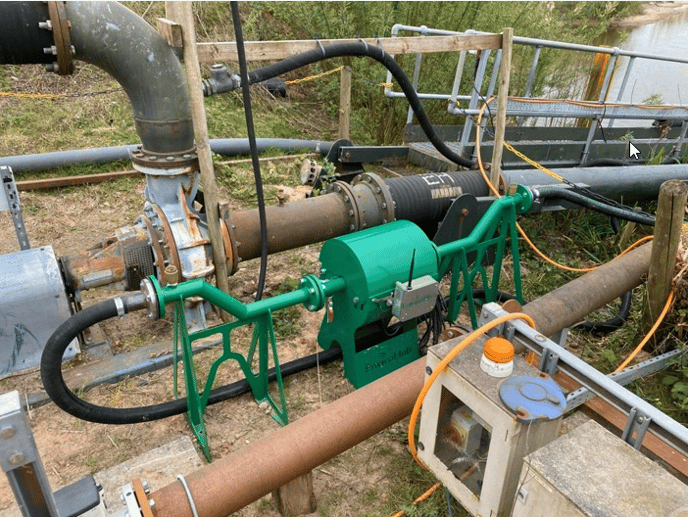
Solution
Negating the need of a sampling pump would remove a potential point of breakdown and complexity, and reduce energy use.
The solution Atlantic Pumps developed was to put the turbidity probes into the lagoon itself which would give much faster response time and more accurate control. However its electronics and antenna (it stores real-time data on the cloud) couldn’t be at risk of submersion.
It wasn’t something we had field-tested before, but this client was happy for us to trial a floating sensor module. So, we built a custom-made floating pontoon that keeps the monitoring unit’s electrics, and the attached EnviroHub control module clear of the water, with the probes suspended below the dewatering pipe’s inlet flow.
Results
With the probes in the optimum place, dewatering stops before silt levels encroach on the pipe inlet. This means zero contaminated water is drawn into the pipe, and operations can start again as soon as the water clarity at the inlet level returns to quality specifications.
Removing the need for a continually running recirculation pump has drastically cut energy consumption, while reducing maintenance and wear costs.
The lower power draw has enabled a resilient battery backup allowing dewatering whenever required, with full uptime and 24/7 availability of environmental performance data.
Keeping maximum discharge per 24 hours is automatically controlled by the link between the EnviroHub CM and Senteos.
PDF FILE