![atlantic_pumps_logo.jpg]](https://pages.atlanticpumps.co.uk/hs-fs/hubfs/atlantic_pumps_logo.jpg?height=50&name=atlantic_pumps_logo.jpg)
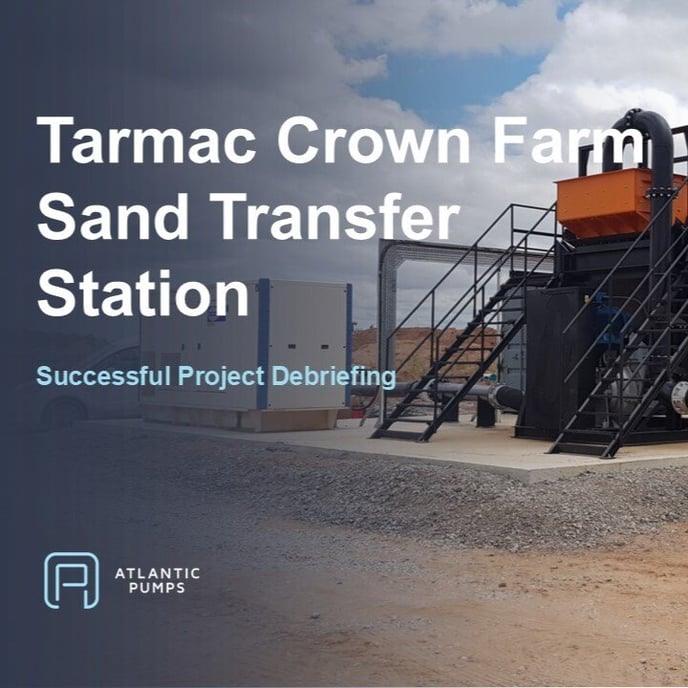
Crown Farm, a sand quarry in Cheshire needed to move 800m3 an hour of dredged sand slurry (25% solids content) 300m across the site.
Owners Tarmac were keen to transport this sand in the most sustainable, effective way, avoiding truck movements, and minimising energy use and water loss.
Atlantic Pumps rose to the challenge with its Sand Slurry Transfer Station.
Not only does this transfer station act as a booster, it also discharges oversize material via a 15m stacker. This optimises the flow and reduces wear load on the sand washing station.
One of the big challenges faced was avoiding sediment settling and blocking the pipework. Due to the high sand content, the flow rate had to remain above the settling velocity at all times throughout the pipe system.
The mainstay of this transfer station is a 55kW 10x8 SlurryPro Slurry pump, 11kW vibrating screening deck, and a stockpiler/stacker for oversize discharge.
As the dredger, washplant, and sand transfer station ran on different control platforms, Atlantic Pumps mechatronic engineers designed a control module that interfaced with all three.
This control interface is programmed to wash out the system with clearer water on shutdown. If the washplant stops, the dredger arm rises into clearer water, which provides a wash-through of the system to clear out sludge settlement. After a programmed time delay, the dredge pump shuts down, followed by the transfer station.
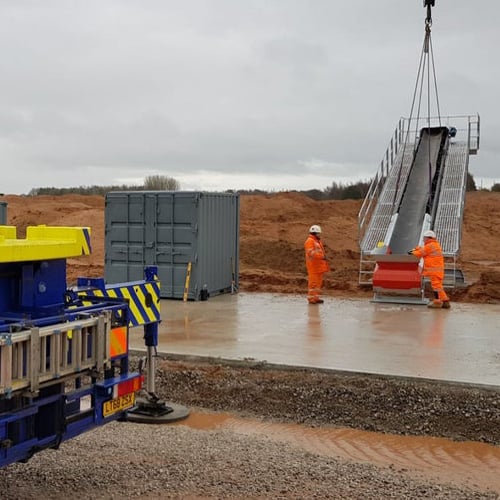
Process water exiting the washplant is returned to the lagoon, which is being retained in view of its future life as a nature lake.
This sand slurry transfer method brings many advantages over the use of heavy mobile plant:
- Health and Safety improvements from less heavy plant crossing the site.
- Reduced noise, lessening the need for abatement
- The fully-electrified process means grid or locally generated renewable energy can be used. This is more efficient than diesel power, and drastically reduces the CO2 footprint.
Automation provides protection from blockages and provides a smoother process flow, regardless of shift patterns or staff shortages.
Washplant outage no longer means sand-blocked pipes. By reducing the density and viscosity of the slurry prior to pump shutdown (reduction of velocity) prevents sand settlement in the pipes.
The removal of oversize at an early stage protects the washplant and downstream pipework, and increases efficiency.
Similar booster stations can be linked in series to transport sand slurry long distances - a greener alternative to haul trucks.